Advertzer
Showing posts with label DELHI DARSHAN. Show all posts

Monday, April 25, 2011

DELHI


TOURISM IN DELHI (CAPITAL OF INDIA)
Delhi is the capital city of India. A fine blend of old and new, ancient and modern, Delhi is a melting pot of cultures and religions. Delhi has been the capital of numerous empires that ruled India, making it rich in history.
Located on the banks of the River Yamuna, Delhi has been known to be continuously inhabited since at least the 6th century BC, though human habitation is believed to have existed since the second millennium BC.Delhi is also widely believed to have been the site of Indraprastha, the legendary capital of the Pandavas during the times of the Mahabharata. It is the site of many ancient and medieval monuments, archaeological sites and remains. In 1639, Mughal emperor Shahjahan built a new walled city in Delhi which served as the capital of the Mughal Empire from 1649 to 1857.
Being one of the most historic capitals in the world, Delhi has many tourist sites.
The rulers left behind their trademark architectural styles. Delhi currently has many renowned historic monuments and landmarks such as the Tughlaqabadfort, Qutub Minar, Old fort(Purana Quila), Lodhi Gardens, Jama Masjid, Humayun's tomb, Red Fort, and Safdarjung's Tomb. Modern monuments include Jantar Mantar, India Gate, Rashtrapati Bhavan, Laxminarayan Temple, Garden of five senses ,Lotus temple and Akshardham Temple.

Friday, April 8, 2011

LODHI GARDEN OR LODI GARDEN (DELHI)


Lodi Gardens is a park in Delhi, India. situated between Khan Market and Safdarjung's Tomb on Lodi Road. It is beautiful and serene, and is a hotspot for morning walks for the Delhiites. Spread over 90 acres (360,000 m2), Lodi Garden is famous among the joggers of the Delhi city of India.Itcontains, Mohammed Shah's Tomb, Sikander Lodi's Tomb, Sheesh Gumbad and Bara Gumbad, architectural works of the 15th century Sayyid and Lodis, a Pashtun dynasty which ruled much of Northern India during the 16th century, and the site is now protected by the Archeological Survey of India (ASI).
MOHAMMED SHAH TOMB
The tomb of Mohammed Shah, the last of the Sayyid dynasty rulers, the earliest of the tombs in the garden, was built in 1444 by Ala-ud-din Alam Shah as a tribute to Mohammed Shah.
The architecture is characterised by the octagonal chamber, with stone chajjaas  on the roof and guldastas on the corners.
SIKANDER LODI TOMB
Another tomb within the gardens is that of Sikander Lodi, which is similar to Mohammed Shah's tomb, though without the chhatris, it was built by his son Ibrahim Lodi in 1517, His tomb is often mistaken to be the Sheesh Gumbad, and is actually situated in near the tehsil office in Panipat, close to the Dargah of Sufi saint Bu Ali Shah Qalandar. It is a simple rectangular structure on a high platform approached by a flight of steps. In the centuries, after the 15th century Sayyid and Lodi dynasties, two villages grew around the monuments, but the villagers were relocated in 1936 in order to create the gardens. During British Raj, it was landscaped by Lady Willingdon, wife of Governor-General of India, Marquess of Willingdon, and hence named the 'Lady Willingdon Park' upon its inauguration on April 9, 1936, and 1947, after Independence, it was given its present name, Lodi Gardens.
BARA GUMBAD
In the middle of the gardens is the BARA GUMBAD ("Big Dome"), it consists of a large rubble-construct dome, it is not a tomb but a gateway to an attached a three domed masjid (mosque), both built in 1494 during the reign of Sikander Lodi, there is also a residence surrounding a central courtyard, where the remains of a water tank can be seen.
SHEESH GUMBAD
Opposite the Bara Gumbad is the Sheesh Gumbad ("Glass dome") for the glazed tiles used in its construction, which contains the remains of an unknown family, this was also built during the reign of Sikander Lodi.
ACCOMMODATION
There are lots of Luxury and Budget Hotels/Resorts near Lodhi garden, available at affordable prices.


HOW TO REACH LODHI GARDEN

Lodi Gardens being located in the capital city, So you can easily reach from any where by means of road transport .

Nearest International Airport: Indira Gandhi International Airport
Nearest Railway Station: New Delhi Railway Station
Nearest Metro Station: Central Secretariat
Nearest Bus Stop: Local buses from various points

Friday, April 1, 2011

JAMA MASJID (DELHI)


The Masjid-i Jahān-Numā the 'World-reflecting Mosque commonly known as the Jama Masjid of Delhi, is the principal mosque of Old Delhi in India. Commissioned by the Mughal Emperor Shah Jahan, builder of the Taj Mahal, and completed in the year 1656 AD, it is the largest and best-known mosque in India. It lies at the origin of a very busy central street of Old Delhi opposite to RED FORT, the Chawri Bazar Road. The courtyard of the mosque can hold up to twenty-five thousand worshippers.
The foundation of the historic Jama Masjid  was laid on a hillock in Shahjahanabad by fifth Mughal Emperor of India, Shahjahan, on Friday, October 6, 1650 AD, (10th Shawwal 1060 AH). The mosque was the result of the efforts of over 5,000 workers, over a period of six years. The cost incurred on the construction in those times was 10 lakh (1 million) Rupees. Shah Jahan built several important mosques in Delhi, Agra, Ajmer and Lahore.Jama masjid has three gates ,four towers and two minarets of about 40 m height built by red sandstone and white marbles. The northern gate of the mosque has 39 steps. The southern side of the mosque has 33 steps. The eastern gate of the mosque was the royal entrance and it has 35 steps. These steps used to house food stalls, shops and street entertainers.
The mosque stands on a platform of about five feet (1.5 m) from the pavement of the terrace, and three flight of steps lead to the interior of the mosque from the east, north, and the south. The floor of the mosque is covered with white and black marble ornamented to imitate the Muslim prayer mat; a thin black marble border is marked for the worshippers, which is three feet long and 1 ½ feet wide. In total there are 899 such spaces marked in the floor of the mosque.

Tourists can enter the Masjid from the North or South gate and it is mandatory for both men and women to remove their shoes and cover themselves modestly, from head to toe.


VISITING TIME: On all days from Sunrise to Sunset
Summer/ Winter: 7.00 am-12.15 pm & 1.45 pm till sunset/ 8.30 am-12.15 pm & 1.45 pm till sunset.

ENTRY FEE: Free to all

HOW TO REACH JAMA MASJID
BY AIR:
Indira Gandhi International Airport of New Delhi is directly connected to all the important cities in the world with all the majors in the airlines industry.
Palam Airport is the Domestic Airport which connects Delhi to the other cities of India. From both airports you can hire vehicles like taxi or auto rikshaw.
BY RAIL:
Being a capital, Delhi is very well connected to every part of India by train. Old Delhi, Hajrat Nijamuddin and New Delhi are the main railheads in Delhi. You have an exclusive option of metro railway to roam in the city for your fast moving nearest METRO STATION  is Kashmiri Gate metro station

BY ROAD:
By road you can come to Delhi by numerous bus options or taxi. All types of vehicles will take you here. You can hire a taxi, auto rikshaw or cycle rikshaw to reach Jama Masjid. You also have an option of public transport buses for cheaper way of transportation. 

Accommodation:
As the Jama Masjid is situated in the heart of the capital city of India, you are served with numerous options. In old Delhi i.e. around Jama Masjid you can get many low cost and medium cost hotels and lodges. If you head towards New Delhi, you can have numerous options of 3 star, 5 star and 7 star hotels.

GET DIRECTIONS:

View Larger Map

Monday, March 28, 2011

Qutub Minar (DELHI)


The Qutub Minar is a tower located in Delhi, India. It is the world's tallest brick minaret with a height of 72.5 meters (237.8 ft). It has a diameter of 14.32m at the base and about 2.75m on the top.

Qutub Minar, an architectural marvel of the 13th century, is located in Delhi, the capital of India. One of the most famous landmarks of Delhi, viewing it is trully an experience to relish. Qutub Minar complex monuments are listed in the UNESCO world heritage sites of India. Here is concise information about Qutub Minar in Delhi. Qutb-u'd-Din Aibak, the first sultan of Delhi, laid the foundation stones of Kutub Minar in AD 1199. Some historian opine that that the objective behind its construction was to give a platform to Mu'azzin to give calls for prayer. He was the one who raised the first storey. Then he died. The credit of completing the construction goes his successor and son-in-law, Shamsu'd-Din Iitutmish, who also added three more stories to it.


MAIN ATTRACTIONS IN QUTUB COMPLEX   

Alai Darwaza

The Alai Darwaza is the main gateway from southern side of the Quwwat-ul-Islam Mosque. It was built by the second Khilji Sultan of Delhi, Ala-ud-din Khilji in 1311 AD, who also added a court to the pillared to the eastern side.

Quwwat-ul-Islam Mosque

Quwwat-ul-Islam mosque (Might of Islam) (also known as the Qutb Mosque or the Great Mosque of Delhi) was built by Qutb-ud-din Aybak, founder of the Mamluk or Slave dynasty.

Iron Pillar
Iron Pillar in the Qutab Minar Complex harks back to the 5th century. It has faced the wear and tear of time successfully

Tombs

Iltutmish

The tomb of Slave Dynasty ruler, Iltutmish, the second Sultan of Delhi (r. 1211-1236 AD), built 1235 AD is also part of the Qutb complex at Mehrauli.


Imam Zamin

Tomb of Imam Muhammad Ali, or Imam Zamin, stand on a raised courtyard, next to the Alai Darwaza. According to an inscription of the eastern entrance to the tomb, Imam Zamin was a saint from Turkestan, who settled in India in around 1500, during the Sikander Lodhi

Alauddin Khilji's tomb and madarsa

At the back of the complex, southwest of the mosque, stands an L-shaped construction, consisting of Alauddin Khilji's tomb dating ca 1316 AD, and a madarsa, an Islamic seminary built by him. Khilji was the second Sultan of Delhi from Khilji dynasty, who ruled from 1296 to 1316 AD.

Alai Minar

Alauddin Khilji started building the Alai Minar, after he had doubled the size of Quwwat ul-Islam mosque. He conceived this tower to be two times higher than Qutb Minar in proportion with the enlarged mosque. The construction was however abandoned, just after the completion of the 24.5 meter high first storey core; soon after death of Ala-ud-din in 1316 AD.

BEST TIME TO VISIT: October to March

HOW TO REACH QUTUB MINAR

By Air : Delhi has two airports – Indra Gandhi International Airport and Palam Domestic Airport. Both these airports are connected with regular flights from important cities of the country and the world as well. Frequent shuttles run between these airports.

By Train : Delhi has three major railheads namely – Delhi, New Delhi and Hazrat Nizamuddin railway station. These stations are served by many express and super fast trains from various parts of the country.

By Bus : Good motorable roads including National Highways and State Highway link Delhi with nearby states and rest of the country.

Local Transport : Buses, Taxis, Cars, Auto-rickshaws are available as local modes of transport, you can reach Qutab Minar by opting any mode. Metro railway is new attraction in Delhi but presently it is not linked to Qutab Minar.


ACCOMODATION

Plenty of accommodation options are available in Delhi that suit your budget. Choose from wide array of hotels ranging from five star to tourist lodges and enjoy a pleasant stay during your Delhi trip.

GET DIRECTIONS

View Larger Map

Friday, March 25, 2011

HUMAYUN TOMB (DELHI)


Humayun's Tomb:
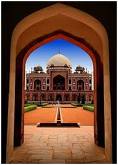
Humayun's senior widow Bega Begum, popularly known as Haji Begum, built the magnificent Humayun's Tomb in Delhi, in 1565. It is one of the most beautiful Mughal monuments, with features like high arches and a full double dome. Located on Mathura Road, near its crossing with Lodi Road, Humayun's Tomb is built on a large stone platform, surrounded by green lawns and has a crescent on the top of the dome, instead of the usual lotus. It is said that the Begum spent one and a half million rupees on the tomb, which was constructed between nine and fourteen years after the death of the Emperor Humayun in 1556.
Mirak Mirza Ghiyas, the architect of Humayun's Tomb, designed it in a Persian 'charbagh' or square four-garden style enclosed by high walls on three sides, and the River Yamuna on the other. The style was introduced in India by Babur, the first Mughal emperor.


Timings: Open on all days from sunrise to sunset
Preferred Timings: Late afternoon is the best time to see Humayun's Tomb, because the natural light aids photography
Admission Fee: INR 10 for citizens/ INR 250 for foreigners


How to Reach: Tourists can either take local buses from various points within the city to reach this monument, which is located on Mathura Road or they can hire auto-rickshaws and taxis or take the metro rail.
Nearest Railway Station: Nizamuddin Railway Station
Nearest Functional Metro Station: Kendriya Terminal
Nearest International Airport: Indira Gandhi International Airport 

GET DIRECTIONS


View Larger Map

Monday, March 21, 2011

GARDEN OF FIVE SENSES (DELHI)


GARDEN OF FIVE SENSES (DELHI).


The Garden of five senses is a breadth taking and enamoring experience. It is not just a park - it is a celebration of aesthetic expression and appreciation, a seamless dialogue between the creations of man and nature that invites interaction and exploration. The Garden of five senses is the latest addition to Delhis cultural circuit. The unique area of the garden with all its natural and man made surrounding has added a new dimension to life in Delhi and caters to all sections of society. The garden is located at Said-ul-Aizab village , close to the Mehrauli heritage area in New Delhi. The garden is built on a large expanse of land, 20 acres to be precise. It was inaugurated in February 2003 by Chief Minister of Delhi. There is an abundant display of flora, with a vast congregation of about 200 special varieties of plants and flowers under one roof.


Attractions Of Garden Of Five Senses

Khas Bagh is developed on the pattern of Mughal Gardens though with a series of modern water channels and fountains, some fitted with a lighting system enhancing the whole beauty of the garden.

Neel Bagh a pool of water lilies, surrounded by a bower like structure covered with colorful plants.

Color Gardens and The Courts of Specimen Plants

The Solar Energy Park

The Solar Park was set up with the assistance of the Ministry of Non-conventional Renewable Energy Sources with the aim of promoting awareness about renewable sources of energy. The main exhibits of the solar park are the two solar-powered Buses, Bicycles, Cars, and a Computer among other things.


Annual Events

Various festivals are held here from time to time which attracts a horde of visitors. The Garden Tourism Festival, Food Festivals, Different Melas, Dandiya Festivals and other cultural programs are held here at different times. For


ENTRY FEE: There is no entrance fee for the Garden of Five Senses. Entry is free and unrestricted.
ENTRY TIMING: It remains open on all days from sunrise to sunset.
TIMING FOR VISIT: 6.00 a.m. to 9.00 p.m


HOW TO REACH GARDEN OF FIVE SENSES: Delhi is well linked by road, rail and air to all parts of the country. After reaching Delhi, tourists can board buses, rickshaws, autos or even hire a cab to reach Garden of Five Senses. Metro rail may also be availed of for reaching here.
Nearest Railway Station :- Nizamuddin Railway station
Nearest Metro Station :- Central Secretariat
Nearest Airport :- Indira Gandhi International Airport
GET DIRECTIONS

View Larger Map

Friday, March 18, 2011

RED FORT ( Lal Qila ) DELHI

RED FORT (Lal Qil'ah or Lal Qila ) DELHI

Red fort lies along the Yamuna River. The layout of the Red Fort was organised to retain and integrate this site with the Salimgarh Fort.

Shah Jahan shifted his capital from Agra to Shahjahanabad and laid the foundation of Red Fort, or the Lal Quila, on 16th April 1639. It took nine years to build this mighty citadel and it got completed on 16th April 1648. It is said that about one crore rupees, an astronomical sum in those days, was spent on its construction. Built of red sandstone, it is octagonal in shape, with two longer sides on the east and west. The perimeter of its strong ramparts is about 2.41 km. Red Fort rises to a height of 33.5 m on the town side and 18 m along the river. A wide moat surrounds the fort, which was originally connected with the river and was always filled with water. The two main gateways, known as Lahori Gate and Delhi Gate,The master builders of the Red Fort were Hamid and Ahmad. Visitors are allowed only in a part of Red Fort, as the army occupies the rest of it. It was designated a UNESCO World Heritage Site in 2007.


MAIN ATTRACTIONS OF RED FORT

Diwan-i-Am                        
Diwan-i-Am or Hall of Public Audience is situated in the Red Fort of Delhi.

Hamam
The hammams or royal baths; these consist of three rooms topped by domes, with a fountain in the center


Moti Masjid
To the west of the hammam is the Moti Masjid, the Pearl Mosque. This was a later addition, built in 1659 as a private mosque for Aurangzeb, Shah Jahan's successor.

Mumtaz Mahal               
One of the original six main-palaces situated along the river front, Mumtaz Mahal was also known as 'Chhoti Baithak'.

Naubat Khana                  

Naubat Khana, or Naqqar Khana (meaning the Drum House), is situated at the entrance of the palace area. Here music was played five times a day at the appointed hours.

Nahr-i-Bihisht
A beautiful water channel called 'Nahr-i-Bihisht' (meaning Stream of Paradise) flew through these palaces.

HOW TO REACH RED FORT

Delhi is well connected by air, rail, and road with important centers of India. Tourists can reach the Red Fort in many ways. They can either take local buses from various points within the city, which is located near the Interstate Bus Terminus at Kashmere Gate in the heart of the city, or, alternatively, they can hire auto-rickshaws and taxis for the purpose. There are also regular buses from other important bus termini like the Interstate Bus Terminus at Sarai Kale Khan and Connaught Place to this monument.


ACCOMODATION

There are several hotels near Red Fort to cater to the accommodation needs of the guests offering them a chance to spend some quality time in the precincts of these medieval structures.

GET DIRECTIONS

View Larger Map

Wednesday, March 9, 2011

LOTUS TEMPLE (BAHAI TEMPLE) DELHI


The Lotus Temple (Bahá'í Temple)House of Worship located On Baharpur Hills near Kalkaji in South Delhi, delhi ,India, popularly known as the Lotus Temple due to its flowerlike shape, is a Bahá'í House of Worship and also a prominent attraction in Delhi. It was completed in 1986 and serves as the Mother Temple of the Indian subcontinent. Fariborz Sahba is recognized as the architect of this beautiful structure, who is an Iranian.It has won numerous architectural awards and been featured in hundreds of newspaper and magazine articles, Since its inauguration to public worship in December 1986, the Bahá'í House of Worship in Delhi has, as of late 2002, attracted more than 50 million visitors, it welcomes four million visitors each year (about 13,000 every day or 9 every minute).
Following the Bahai faith, Lotus Temple is open to people of all religions. It is a perfect place to practice meditation and attain peace of mind. The Temple doesn't observe any kind of sermons or rituals. The visitors are required to maintain silence inside the hall.


Best Season: February - March
Timings:
Open during summer (1st April - 30th September) - 9:00 a.m. to 7:00 p.m.
Winter (1st October - 31st March) - 9:30 a.m. to 5:30 p.m.
Closed every Monday

Place to visit near Lotus Temple
# Kalkaji Mandir
# ISKON Temple


HOW TO REACH LOTUS TEMPLE

Tourists can reach upto Nehru Place (the bus terminal is well connected to every part of the city), from where one can take an auto-rickshaw or walk for 15 minutes.

View Larger Map

Monday, March 7, 2011

OLD FORT (PURANA QUILA)DELHI

                                                                                            
 PURANA QUILA(OLD FORT) DELHI
Purana Qila ( Old Fort), is the inner citadel of the city of Dina-panah, founded by the second Mughal Emperor, Humayun in 1533 and completed in 1538. Purana Qila, situated on the banks of Yamuna, was constructed by the Mughal emperor Humayun. It is where Humayun's capital Din Panah was located. Later it was renovated and named Shergarh by first Afghan emperor of India, Sher Shah Suri. Old Fort is located just south-east of India Gate and north of Humayun’s Tomb and the Nizamuddin Railway Station.

Qila-i-Kuhna Mosque

                                                                              
The single-domed Qila-i-Kuna Mosque, built by Sher Shah in 1541 is an excellent example of a pre-Mughal design, and an early example of the extensive use of the pointed arch in the region as seen in its five doorways with the 'true' horseshoe-shaped arches. It was designed as a Jami Mosque, or Friday mosque for the Sultan and his courtiers. The prayer hall inside, the single-aisled mosque, measures 51.20m by 14.90m and has five elegant arched prayer niches or mihrabs set in its western wall. At one time, the courtyard had a shallow tank with a fountain.
Sher Mandal
The Sher Mandal stands to the south of the mosque. This double-storeyed octagonal tower of red sandstone with steep stairs leading up to the roof, It was built by Sher Shah. This was also the tragic spot where, on 24 January 1556 Humayun slipped while on his way to the evening namaz, fell headlong down the stairs and died of his injuries two days later.                           
                                                                    
Several other monument also lie around the complex, like Kairul Manzil, mosque built by Maham Anga, Akbar's foster-mother, and which was later used as a madarsa. Sher Shah Suri Gate or Lal Darwaza, which was the South Gate to Shergarh, the city he founded, also lies opposite the Purana Qila complex, across Mathura Road, south-east of the Kairul Manzil.
SPECIAL ATTRACTION
Sound and Light Show : The Sound and Light show at the Old Fort is an added attraction which you should not miss. During this one hour show, the rise and fall of Delhi from Indraprastha to Mughal era becomes live in Sound and Light. Voice of this Sound and Light show has been given by Bollywood personalities like Jaya Bachchan, Om Puri and others.
Show Timings
English Version : September to October & February to April – 20.30 p.m to 21.30 p.m.
November to January – 19.30 p.m. to 21.30 p.m.
May to August – 21.00 p.m to 22.00 p.m.

# Show Timings may vary, please confirm the timings from the Booking counter ITDC, Connaught Place or concerned authority.
            
                                                                         
HOW TO REACH OLD FORT DELHI
By Air : Delhi is well-connected by several domestic and international flights with important places of India and the world. Indra Gandhi International Airport and Palam airport are the two main airports of Delhi. These airports are five mnts away from each other and served by regular shuttle services.

By Train : Delhi, New Delhi and Hazrat Nizamuddin railway station are three main railheads of Delhi. Several mail, super fast, Rajdhani and Superfast trains connect Delhi to rest of the country.

By Bus : National Highways and State Highways connect Delhi with neighbouring states and other parts of India. Buses of DTC (Delhi Transport Corporation) and other State Transport Corporation ply to and from Delhi.

Apart from buses, taxis, cars, auto-rickshaws and metro are other local modes of transport. You can reach Old Fort by taking any mode of local transport.
ACCOMMODATION
Accommodation is not at all a problem in Delhi as the city is dotted with hundreds of good hotels, lodges, rest houses etc. You may opt any of the accommodation option as per your budget and requirement.


View Larger Map

Saturday, March 5, 2011

AKSHARDHAM TEMPLE DELHI


Akshardham is a Hindu temple complex in Delhi, India. The temple is located near Noida in East Delhi. Also referred to as Delhi Akshardham or Swaminarayan Akshardham, the complex displays millennia of traditional Indian and Hindu culture, spirituality, and architecture. The building was inspired and moderated by Pramukh Swami Maharaj, the spiritual head of the Bochasanwasi Shri Akshar Purushottam Swaminarayan Sanstha, whose 3,000 volunteers helped 7,000 artisans construct Akshardham.

The temple, which attracts approximately 70 percent of all tourists who visit Delhi, was officially opened on 6 November 2005.It sits on the banks of the Yamuna adjacent to the 2010 Commonwealth Games village.The monument, at the center of the complex, was built off of the Vastu Shastra and Pancharatra Shastra. The complex features a large central monument crafted entirely of stone, exhibitions on incidents from the life of Swaminarayan and the history of India, an IMAX feature, a musical fountain, and large landscaped gardens. The temple is named after a belief in Swaminarayan Hinduism.


MAIN ATTRACTIONS OF AKSHARDHAM TEMPLE

1.Hall of Values

Also known as Sahajanand Pradarshan, which display incidents from Swaminarayan's life, portraying his message about the importance of peace, harmony, humility, service to others and devotion to God.

2.Theatre

Named Neelkanth Kalyan Yatra, the theatre houses Delhi's first and only large format screen, measuring 85-foot (26 m) by 65-foot (20 m). The theatre shows a film specially commissioned for the complex, Neelkanth Yatra, to recount a seven-year pilgrimage made by Swaminarayan made during his teenage years throughout India

3.Musical fountain

Known as the Yagnapurush Kund, it is India's largest step well. It features a very large series of steps down to a traditional yagna kund. During the day, these steps provide rest for the visitors to the complex and at night, a musical fountain show representing the circle of life is played to an audience which is seated on the same steps.


4.BOAT RIDE

Named Sanskruti Vihar, this ride takes visitors on a journey through 10,000 years of Indian history in approximately 12 minutes. Visitors sit in specially designed peacock shaped boats that make their way around an artificial river.


5.Garden of India

Also known as the Bharat Upavan, this garden has lush manicured lawns, trees, and shrubs. The garden is lined with bronze sculptures of contributors to India's culture and history. These sculptures include children, women, national figures, freedom fighters, and warriors of India.

6. Yogi Hraday Kamal

            A sunken garden, shaped like a lotus when viewed from above, 


7. Neelkanth Abishek

Devotees offer abhishek, a ritual of pouring water on to the murti of Neelkanth Varni, and express their reverence and prayers for spiritual upliftment and fulfillment of wishes.

8. Narayan Sarovar

The Narayan Sarovar is a lake that surrounds the main monument. The lake contains holy waters from 151 rivers and lakes that are believed to have been sanctified by Swaminarayan.


9. Premvati Ahargruh

The Premati Ahargruh or the Premvati Food Court is a vegetarian restaurant, an Ayurvedic bazaar. The restaurant caters to a variety of traditional dishes.

10. AARSH Centre

The Akshardham Centre for Applied Research in Social Harmony or the AARSH Centre is a centre within the complex that applies research of social harmony and related topics. Scholars and students may conduct practical research through AARSH. Researchers have the ability to carry out their research projects and affiliate their papers with AARSH. Studies on education, medicare, tribal and rural welfare, ecology, and culture are conducted within the centre.

TIMING:

Entry is permitted from 9AM to 6.30PM
CLOSED ON MONDAY
(You have to deposit your cellphones and other metallic items at the entrance for security reasons)

HOW TO REACH AKSHARDHAM TEMPLE DELHI

From NewDelhi Railway Station : Akshardham is about 10 km from here.You should come out of the Railway station from Platform No.12 Side ( Not by Platform NO.1) ; About Rs.100 by Auto Rickshaw.
From Nizamuddin Raliway Station : It is about 4 KM . you can go by auto rickshaw or prepaid taxi. They will charge you around Rs.100
Nearest Delhi Metro Railway Station : AKSHARDHAM METRO STATION.
FROM YOU CAN WALK ON FOOT TO THE TEMPLE.

FEE and CHARGES :
Rs. 125 FOR visit halls1, 2 and 3
Rs.75    FOR theatre
Rs.20    FOR fountain


View Larger Map

TUGHLAQABAD FORT DELHI


TUGHLAQABAD FORT DELHI
                                                                 
Tughlaqabad Fort is a ruined fort in Delhi, stretching across 6.5 km, built by Ghiyas-ud-din Tughlaq, the founder of Tughlaq dynasty, of the Delhi Sultanate of India in 1321, which was later abandoned in 1327. It lends its name to the nearby Tughlaqabad residential-cum-commercial area as well as the Tughlaqabad Institutional Area

The story behind the foundation of Tughlaqabad is an interesting one. Ghazi Malik, the founder of the Tughlaq dynasty, was once a slave of Mubarak Khilji, the last Khilji sultan. One day, while walking by the area where the Tughlaqabad Fort is now located, Ghazi Malik suggested to his master that the rocky prominence would be an ideal site for building a fort. The Khilji sultan laughed at his slave and suggested that the slave build a fort there when he became a sultan. When Ghazi Malik, as Ghiyas-ud-din Tughlaq, founded the Tughlaq Dynasty in 1321, he did just that-Tughlaqabad is Delhi's most colossal and awesome fort, even in its ruined state.
The fort of Tughlaqabad was completed rapidly in a short span of four years (1321-25).


HOW TO REACH TUGHALAQBAD FORT

Delhi is well connected by air, rail, and road with important cities of India and abroad. Travelers have to reach the Qutab Minar complex in order to see the Tughlaqabad Fort. They can either take local buses from various points within the city to reach this complex, which is located in the southern part of the city, or, alternatively, they can hire auto-rickshaws and taxis for the purpose. There are regular buses from important bus termini like the Interstate Bus Terminus at Kashmere Gate and Sarai Kale Khan and Connaught Place to this monument. Local guided tours conducted by Delhi Tourism and private operators cover this important monument.Travellers  can also take state transport bus service specialy started for them.

 DELHI DARSHAN

DTC daily operates Sight Seeing Tours from Scindia House.  The fare of Delhi Darshan Service AC bus is Rs.200/- for adult and Rs.100/- for the children between the age of 5 –12 years.  However the children will not be entitle for seat in the bus.

The time of journey will be from 0915 to 17.45 hrs
.. 
                                                                                

View Larger Map