Advertzer
Showing posts with label WORLD HERITAGE CITY DELHI. Show all posts

Monday, March 28, 2011

Qutub Minar (DELHI)


The Qutub Minar is a tower located in Delhi, India. It is the world's tallest brick minaret with a height of 72.5 meters (237.8 ft). It has a diameter of 14.32m at the base and about 2.75m on the top.

Qutub Minar, an architectural marvel of the 13th century, is located in Delhi, the capital of India. One of the most famous landmarks of Delhi, viewing it is trully an experience to relish. Qutub Minar complex monuments are listed in the UNESCO world heritage sites of India. Here is concise information about Qutub Minar in Delhi. Qutb-u'd-Din Aibak, the first sultan of Delhi, laid the foundation stones of Kutub Minar in AD 1199. Some historian opine that that the objective behind its construction was to give a platform to Mu'azzin to give calls for prayer. He was the one who raised the first storey. Then he died. The credit of completing the construction goes his successor and son-in-law, Shamsu'd-Din Iitutmish, who also added three more stories to it.


MAIN ATTRACTIONS IN QUTUB COMPLEX   

Alai Darwaza

The Alai Darwaza is the main gateway from southern side of the Quwwat-ul-Islam Mosque. It was built by the second Khilji Sultan of Delhi, Ala-ud-din Khilji in 1311 AD, who also added a court to the pillared to the eastern side.

Quwwat-ul-Islam Mosque

Quwwat-ul-Islam mosque (Might of Islam) (also known as the Qutb Mosque or the Great Mosque of Delhi) was built by Qutb-ud-din Aybak, founder of the Mamluk or Slave dynasty.

Iron Pillar
Iron Pillar in the Qutab Minar Complex harks back to the 5th century. It has faced the wear and tear of time successfully

Tombs

Iltutmish

The tomb of Slave Dynasty ruler, Iltutmish, the second Sultan of Delhi (r. 1211-1236 AD), built 1235 AD is also part of the Qutb complex at Mehrauli.


Imam Zamin

Tomb of Imam Muhammad Ali, or Imam Zamin, stand on a raised courtyard, next to the Alai Darwaza. According to an inscription of the eastern entrance to the tomb, Imam Zamin was a saint from Turkestan, who settled in India in around 1500, during the Sikander Lodhi

Alauddin Khilji's tomb and madarsa

At the back of the complex, southwest of the mosque, stands an L-shaped construction, consisting of Alauddin Khilji's tomb dating ca 1316 AD, and a madarsa, an Islamic seminary built by him. Khilji was the second Sultan of Delhi from Khilji dynasty, who ruled from 1296 to 1316 AD.

Alai Minar

Alauddin Khilji started building the Alai Minar, after he had doubled the size of Quwwat ul-Islam mosque. He conceived this tower to be two times higher than Qutb Minar in proportion with the enlarged mosque. The construction was however abandoned, just after the completion of the 24.5 meter high first storey core; soon after death of Ala-ud-din in 1316 AD.

BEST TIME TO VISIT: October to March

HOW TO REACH QUTUB MINAR

By Air : Delhi has two airports – Indra Gandhi International Airport and Palam Domestic Airport. Both these airports are connected with regular flights from important cities of the country and the world as well. Frequent shuttles run between these airports.

By Train : Delhi has three major railheads namely – Delhi, New Delhi and Hazrat Nizamuddin railway station. These stations are served by many express and super fast trains from various parts of the country.

By Bus : Good motorable roads including National Highways and State Highway link Delhi with nearby states and rest of the country.

Local Transport : Buses, Taxis, Cars, Auto-rickshaws are available as local modes of transport, you can reach Qutab Minar by opting any mode. Metro railway is new attraction in Delhi but presently it is not linked to Qutab Minar.


ACCOMODATION

Plenty of accommodation options are available in Delhi that suit your budget. Choose from wide array of hotels ranging from five star to tourist lodges and enjoy a pleasant stay during your Delhi trip.

GET DIRECTIONS

View Larger Map

Friday, March 25, 2011

HUMAYUN TOMB (DELHI)


Humayun's Tomb:
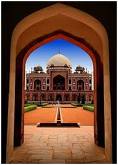
Humayun's senior widow Bega Begum, popularly known as Haji Begum, built the magnificent Humayun's Tomb in Delhi, in 1565. It is one of the most beautiful Mughal monuments, with features like high arches and a full double dome. Located on Mathura Road, near its crossing with Lodi Road, Humayun's Tomb is built on a large stone platform, surrounded by green lawns and has a crescent on the top of the dome, instead of the usual lotus. It is said that the Begum spent one and a half million rupees on the tomb, which was constructed between nine and fourteen years after the death of the Emperor Humayun in 1556.
Mirak Mirza Ghiyas, the architect of Humayun's Tomb, designed it in a Persian 'charbagh' or square four-garden style enclosed by high walls on three sides, and the River Yamuna on the other. The style was introduced in India by Babur, the first Mughal emperor.


Timings: Open on all days from sunrise to sunset
Preferred Timings: Late afternoon is the best time to see Humayun's Tomb, because the natural light aids photography
Admission Fee: INR 10 for citizens/ INR 250 for foreigners


How to Reach: Tourists can either take local buses from various points within the city to reach this monument, which is located on Mathura Road or they can hire auto-rickshaws and taxis or take the metro rail.
Nearest Railway Station: Nizamuddin Railway Station
Nearest Functional Metro Station: Kendriya Terminal
Nearest International Airport: Indira Gandhi International Airport 

GET DIRECTIONS


View Larger Map

Saturday, March 5, 2011

TUGHLAQABAD FORT DELHI


TUGHLAQABAD FORT DELHI
                                                                 
Tughlaqabad Fort is a ruined fort in Delhi, stretching across 6.5 km, built by Ghiyas-ud-din Tughlaq, the founder of Tughlaq dynasty, of the Delhi Sultanate of India in 1321, which was later abandoned in 1327. It lends its name to the nearby Tughlaqabad residential-cum-commercial area as well as the Tughlaqabad Institutional Area

The story behind the foundation of Tughlaqabad is an interesting one. Ghazi Malik, the founder of the Tughlaq dynasty, was once a slave of Mubarak Khilji, the last Khilji sultan. One day, while walking by the area where the Tughlaqabad Fort is now located, Ghazi Malik suggested to his master that the rocky prominence would be an ideal site for building a fort. The Khilji sultan laughed at his slave and suggested that the slave build a fort there when he became a sultan. When Ghazi Malik, as Ghiyas-ud-din Tughlaq, founded the Tughlaq Dynasty in 1321, he did just that-Tughlaqabad is Delhi's most colossal and awesome fort, even in its ruined state.
The fort of Tughlaqabad was completed rapidly in a short span of four years (1321-25).


HOW TO REACH TUGHALAQBAD FORT

Delhi is well connected by air, rail, and road with important cities of India and abroad. Travelers have to reach the Qutab Minar complex in order to see the Tughlaqabad Fort. They can either take local buses from various points within the city to reach this complex, which is located in the southern part of the city, or, alternatively, they can hire auto-rickshaws and taxis for the purpose. There are regular buses from important bus termini like the Interstate Bus Terminus at Kashmere Gate and Sarai Kale Khan and Connaught Place to this monument. Local guided tours conducted by Delhi Tourism and private operators cover this important monument.Travellers  can also take state transport bus service specialy started for them.

 DELHI DARSHAN

DTC daily operates Sight Seeing Tours from Scindia House.  The fare of Delhi Darshan Service AC bus is Rs.200/- for adult and Rs.100/- for the children between the age of 5 –12 years.  However the children will not be entitle for seat in the bus.

The time of journey will be from 0915 to 17.45 hrs
.. 
                                                                                

View Larger Map

Friday, March 4, 2011

AJANTA ALLORA CAVES

Ajanta Caves in Maharashtra, India


AJANTA is world's greatest historical monument recognised by UNESCO far near from Jalgaon city of Maharashtra, India.
Ajanta is the location of some of the finest examples of ancient Indian sculptures and murals, housed in 28 caves that served as a major Buddhist monastery from the second to seventh century BC. Today, the Ajanta Caves are renowned all over the world for their majestic beauty and is a UNESCO World Heritage Site. At Ajanta, the caves hewn out of the horse-shoe shaped stone cliffs surrounding the River Waghora are an important heritage site, allowing viewers to glimpse the amazing skill of ancient muralists and sculptors. These caves were chiselled out by Buddhist monks between 200 BC and 650 AD as ‘chaityas’ (prayer halls) and ‘viharas’ (monasteries), and contain exquisite frescoes and fine sculptures. One can amble through the Ajanta Caves or take a guided tour – the art contained in these early Buddhist Caves are great works by themselves and one can spend hours studying them. Ajanta caves are classified in two phases known as the Hinayana phase and the Mahayana phase. The former phase depicts scenes in which Lord Buddha was worshipped through some specific symbols
Some of the well known caves are as follows. Cave 1 consists of some of the finest painting specimens, particularly the two bodhisattvas of Padmapani and Vajrapani and an impressive seated Buddha sculpture. Beneath his statue is placed the Wheel of Life which symbolised the teachings of karma and rebirth by Buddha. A striking feature of Cave 2 is its beautiful ceiling painted to resemble a tent and its lovely animated sculptures. The walls of the cave are decorated with intricate patterns depicting scenes of Gautam Buddha’s birth. Cave 9 not only contains sculptures, but remarkably preserved frescoes as well. Cave 11 represents scenes from the early stage of Buddha’s life. In this cave the sculpture of Lord Buddha is attached to a stupa which is a blend of both image and stupa worship. In Cave 12 and Cave 13 one can view the beautiful paintings that glow softly in the dark and gasp at the life-size and miniature sculptures. Cave 15 and Cave 16 explain the pictorial legend, pointing out some of the more amazing aspects of the paintings and sculptures that transform the rocky cave walls. Of particular interest are Cave 17 with its exquisite murals portraying devotees with offerings in the Royal Procession, Cave 19 with some astounding sculptures of Buddha, lion heads and riders and Cave 26 with its impressive carvings from Lord Buddha’s life. 
                                                   

Best time to visit:

Winter months (from October to February) or during the monsoons are a good time to visit the Ajanta Caves.


HOW To REACH AJANTA ALLORA CAVES?


By Air:

Currently Aurangabad is the nearest Air point for Ajanta. It can be reached from New Delhi and Mumbai (Bombay), international airport. Indian airlines as well as Jet Airways have daily flight to Aurangabad from New Delhi and Mumbai.
Jalgaon is also developing its Airport. Soon it will also start. Ajanta Caves is far near from Jalgaon Airport while a bit distant from Aurangabad Airport.

By Rail:

Jalgaon is the best place to drop in for Ajanta if you like Rail journey. It is centre point of all major railway stations of India and has Bhusaval (Just 28kms from Jalgaon) as Second largest depot of railways in entire Asia.
All Super Fast, express, mail and passenger trains stops at Bhusaval and most of them at Jalgaon as well. You can check online status of availability of reservation on Indian railways official website. From Jalgaon, you can pick up Taxi/ state transport department bus to reach ajanta. 

Cave Timings:

9.00AM to 17.30PM Indian Standard Time (IST)
Ajanta Caves remain closed on Monday and Ellora Caves remain closed on Tuesday. BOTH CAVES REMAIN OPEN ON ALL NATIONAL HOLIDAYS

Cave Charges:


1. For Indians below 15 years : FREE of Charge
2. For Indians above 15 years : Rs. 10/- per head
3. For Foreigners above 15 years : US $5 or equivalent in Indian rupees per head
4. For Photo Camera/ Video Camera: Rs. 5/- (Camera to be used without flash)


View Larger Map